

Electric road bike vs road bike: what’s the real difference? We cut through the myths and show how e-road bikes stack up against traditional road bikes, rider to rider.Many riders still ask the question: What’s the real difference between an electric road bike and a normal road bike? It’s a fair one. For years, e-bikes were dismissed as heavy, expensive or “not proper cycling.” Add in the confusion over legality, and it’s no wonder some people hesitate.We’re here to clear it up. This isn’t marketing fluff. Just a straight-talking comparison between electric road bikes and traditional road bikes. We’ll show you where each bike excels, debunk the myths, and help you decide which one fits your riding style.
What Is an Electric Road Bike?
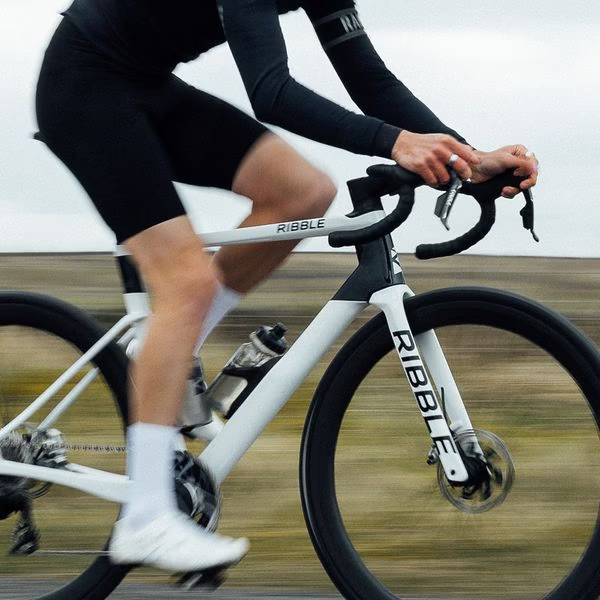
An electric road bike (often called an e-road bike) is, at its heart, still a road bike. They still have drop bars, slim road tyres and lightweight frames. The difference is the addition of a compact motor and battery to provide pedal-assist.In the UK, the assist cuts out at 15.5mph. That’s the law. You’re still pedalling, but the motor simply adds support up to the limit. No throttle, no “sit back and cruise.” Just a boost when you need it. That’s what makes an e-road bike a road-legal electric bike, with no license, tax or insurance required.At Ribble, we’ve designed our e-road range to ride like proper bikes first. The frames are sleek and the carbon is light, with batteries hidden in the downtube. From a distance, you’d never know they were e-bikes. Our mantra is smiles per kilo: the perfect balance of low weight, smart range and the feel of a real road bike.Forget clunky motors or obvious battery packs. These are lightweight electric bikes that look, feel and handle just like the bikes you already ride.
Key Similarities Between Road and Electric Road Bikes
The key point to emphasise is that an electric road bike is still a road bike at its core. Geometry is near-identical. It features the same aggressive lines as racing models, along with the same endurance position for all-day comfort. If you’ve ever ridden a road bike, an e-road feels instantly familiar.Components are also shared, along with the groupsets, wheels, tyres, and finishing kit. Many Ribble e-road models run the same Shimano or SRAM set-ups as our standard road bikes. That means braking, shifting, and handling are what you expect.On the road, most people wouldn’t even notice you’re on an e-bike. We hear it all the time from customers: “I joined a group ride, nobody realised until I mentioned it.” That’s how stealthy they are.So, in terms of looks, feel, and ride, there’s more overlap than difference. You get the same joy of carving through corners and the same buzz of speed. The motor just widens the scope of what’s possible.
Key Differences – Power, Weight and Range
Here’s where things split.Power
- A road bike is 100% leg-driven. Your watts, your output, your engine. An e-road bike adds pedal-assist to smooth climbs, headwinds or fatigue. But it’s not unlimited, as the motor stops helping at 15.5mph. But in those moments where you’d normally grind, the bike feels alive.
- This was once a significant obstacle. E-bikes were often twice the weight of their non-electric cousins. But with Ribble’s carbon monocoque frames and compact motors, some e-road models come in as low as 11.8kg. That’s firmly in the “lightweight electric bike” bracket. For context, many mid-range disc road bikes weigh a similar amount.
- On a standard road bike, your range is defined by legs and fuelling. On an e-road bike, it’s both you and the battery. Ribble’s systems provide up to 100 miles of assistance, depending on the mode, terrain, and rider input. Use it wisely and it’ll get you through long days, tough climbs or epic commutes.
- Picture climbing the same hill twice. On a normal road bike, it’s all about pacing and power output. On an e-road bike, you still pedal and still work, but the motor smooths out the gradient. You crest the top fresher, ready for more.
- Pedal-assist only (no throttle that moves the bike without pedalling)
- Motor rated at 250W or less
- Assistance stops at 15.5mph
Which Is Best for You?
So, should you ride a traditional road bike or an e-road bike? The answer depends on your goals.Why choose a standard road bike?
- Lowest possible weight for climbing or racing
- Pure rider-powered challenge
- Simplicity: no charging, no range to consider
- Extend rides further with the same effort
- Conquer climbs you’d normally avoid
- Arrive fresher on commutes or sportives
- Keep riding through injury, illness or age
- A sportive rider wants to stay with their group all day and finish strong. An e-road bike makes it possible without overcooking their legs.
- A commuter battling headwinds in winter appreciates the boost that keeps arrival times consistent.
- Someone coming back from a knee injury finds an e-road bike a safer, more controlled way to rebuild fitness.
FAQSAre electric road bikes legal in the UK?How heavy is an electric road bike?Can you ride an e-road bike without the assistance?What is the difference between an e-road bike and a normal road bike?Are electric road bikes good for training?
Conclusion
The difference between an electric road bike and a normal road bike isn’t as big as people think. They look and ride alike. The only change is a discreet motor that helps you push further, climb stronger, or ride when you otherwise wouldn’t.Ribble’s lightweight, stealthy electric road bikes break down barriers without changing what makes road cycling great. They’re proper bikes, with something extra.